It’s super-easy to help animals, no matter how old you are. Check out our Top 10 Ways to Save Animals to get a jump-start on making a huge difference in the lives of animal everywhere:
Going vegan means that you don’t eat, wear, or use anything that came from an animal, such as meat, milk, eggs, leather … you get the idea. Just by going vegan, you will save the lives of more than 100 animals every year! Pretty awesome, right? So take the pledge to go vegan already!
2. Complete a Mission
Check out our list of super-easy ways to help animals and earn stickers and comic books for doing it! We post new missions all the time, so there are always new ways for you to spread the word about animal rights and get free stuff. It’s a serious win-win situation.
3. Buy Cruelty-Free
Animals shouldn’t be blinded, poisoned, or burned just for the soap, shampoo, or lip balm we use. But in labs across the country, these things happen all the time. Take a stand against animal testing by buying only cruelty-free products. It’s easy! Just take a look at the package, and make sure that it says that it wasn’t tested on animals.
4. Play a Game
Check out all our super-fun animal rights–themed online games. Try your hand at playing Super Chick Sisters, our most popular game ever! Can you get the top score?
5. Don’t Support Animals in Entertainment
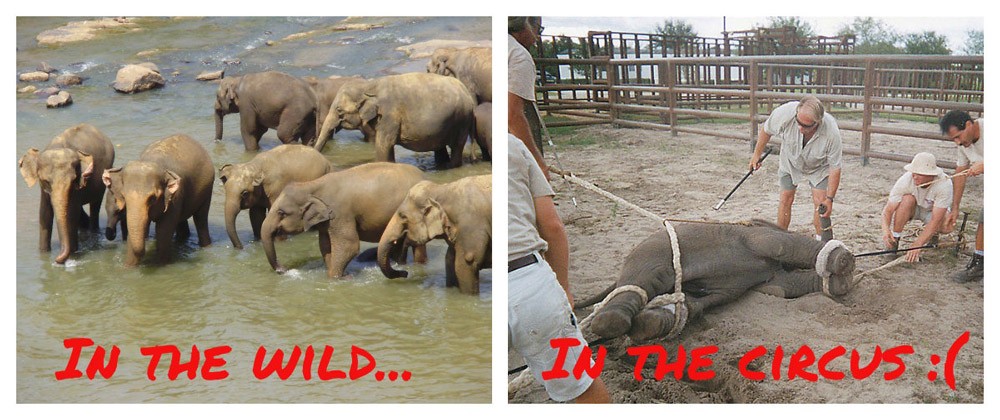
Animals are alive for their own reasons, not to entertain us. Animals in movies, circuses, and zoos are denied everything that is natural and important to them. They will never be allowed to hang out with their families, graze, or do anything that they would do in the wild. Refuse to support this cruelty by never going to a zoo, marine park, or circus that uses animals.
6. Stay Involved
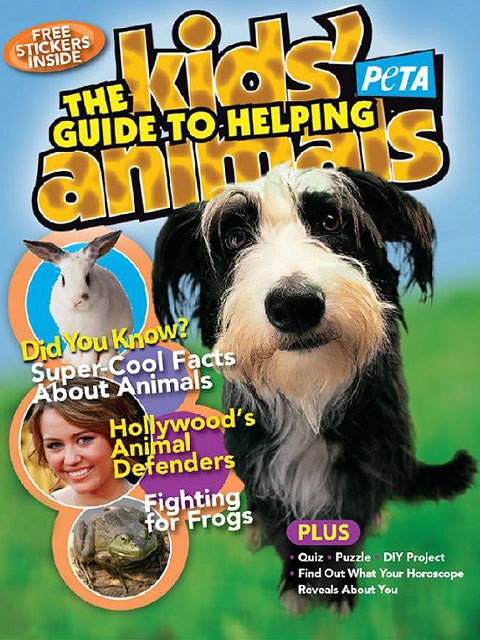
Keep up-to-date on all the new missions, contests, and animals who need your help by having an adult or older sibling “like” PETA Kids on Facebook. Also, sign up to receive PETA Kids e-mails and a FREE Guide to Helping Animals, PETA Kids’ magazine.
7. Volunteer at Your Local Animal Shelter
Animal shelters are always in need of more help! Whether you are helping by walking dogs, cleaning out water bowls, or hanging up signs, we bet they have a job for you. Call your local shelter and ask whether it needs any help. You could make a big difference in the lives of homeless dogs, cats, and other animals!
8. Cut Out Dissection
If your class is planning on dissecting any animal, ask your teacher for a humane alternative assignment, such as using a computer program to perform a virtual dissection. An animal will be saved, and you will actually learn and remember way more!
9. Pledge to Be Fur-Free
Even just “a little bit” of fur trim on mittens, boots, and collars caused tremendous suffering for an animal who was abused and killed on a fur farm or trapped and killed in the wild. Help protect animals by refusing to buy or wear any fur.
Share with your friends why you have decided to stick up for animals and encourage them to get involved, too. Not sure where to start? Tell your friends to order a FREE Guide to Helping Animals!
YIELD
Makes 4 ot 6 servings
INGREDIENTS
Cake:
1 tablespoon unsalted butter, room temperature
1/4 cup natural unsweetened cocoa powder plus more for pan
1/4 cup cake flour
4 large eggs, room temperature
1/2 cup plus 6 teaspoons sugar
1 teaspoon vanilla extract
Chocolate icing:
3/4 cup heavy cream
1 cup semi sweet or bittersweet chocolate chips (do not exceed 61% cacao)
PREPARATION
For cake:
Preheat oven to 400°F. Line the bottom of a 13x9x2" metal baking pan with parchment paper. Butter paper and sides of pan; dust with cocoa powder, tapping out excess. Sift flour and remaining 1/4 cup cocoa powder through a fine-mesh sieve into a small bowl. Repeat sifting 2 more times. Set flour mixture aside. Crack 2 eggs into a large deep bowl. Separate remaining 2 eggs, adding yolks to bowl with whole eggs and placing whites in a medium deep bowl. Set whites aside.
Using an electric mixer, beat whole eggs and yolks on low speed for 1 minute. Increase speed to medium; gradually add 1/2 cup sugar. Beat until mixture is thick and pale, about 3 minutes. Beat in vanilla.
Using clean, dry beaters, beat egg whites until foamy. Sprinkle 1 teaspoon sugar over. Continue to beat until soft peaks form, about 1 minute. Sprinkle remaining 5 teaspoons sugar over and beat until meringue is thick and glossy, about 30 seconds.
Using a rubber spatula, fold half of meringue into egg mixture. Sift half of dry ingredients over batter and fold until just blended. Repeat with remaining meringue and dry ingredients.
Scrape batter into prepared pan, spreading evenly to edges. Bake until cake springs back when pressed gently with your fingertips, 10-12 minutes.
Let cake cool in pan on a wire rack. Run a knife around sides of pan to release cake.
Place a cutting board on top of pan. Invert cake onto board; remove pan. Carefully peel away parchment. Using a serrated knife, trim edges to create an even layer.
For chocolate icing:
Bring cream to a simmer in a small saucepan over medium-low heat. Remove from heat; add chocolate chips and stir until icing is smooth and glossy. Let cool to thicken slightly, about 15 minutes.
Using an offset spatula, spread half of icing down the middle of the cake; smooth evenly to the edges. Cut cake crosswise into 3 pieces. Stack pieces to make 3 layers. Spread remaining icing on sides of cake. DO AHEAD: Can be made 2 days ahead. Store airtight at room temperature.
superbly delicious
GIANT PANDA
Order: Carnivora Family: Ursidae Genus and species:Ailuropoda melanoleuca
GEOGRAPHIC DISTRIBUTION:
Giant pandas live in a few mountain ranges in central China, in Sichuan, Shaanxi, and Gansu provinces. They once lived in lowland areas, but farming, forest clearing, and other development now restrict giant pandas to the mountains.
HABITAT:
Giant pandas live in broadleaf and coniferous forests with a dense understory of bamboo, at elevations between 5,000 and 10,000 feet. Torrential rains or dense mist throughout the year characterizes these forests, often shrouded in heavy clouds.
PHYSICAL DESCRIPTION:
The giant panda, a black-and-white bear, has a body typical of bears. It has black fur on ears, eye patches, muzzle, legs, and shoulders. The rest of the animal's coat is white. Although scientists do not know why these unusual bears are black and white, some speculate that the bold coloring provides effective camouflage into their shade-dappled snowy and rocky surroundings. The panda's thick, wooly coat keeps it warm in the cool forests of its habitat. Giant pandas have large molar teeth and strong jaw muscles for crushing tough bamboo. Many people find these chunky, lumbering animals to be cute, but giant pandas can be as dangerous as any other bear.
SIZE:
About the size of an American black bear, giant pandas stand between two and three feet tall at the shoulder (on all four legs), and reach four to six feet long. Males are larger than females, weighing up to 250 pounds in the wild. Females rarely reach 220 pounds.
STATUS:
The giant panda is listed as endangered in the World Conservation Union's (IUCN's) Red List of Threatened Species. There are about 1,600 left in the wild. More than 300 pandas live in zoos and breeding centers around the world, mostly in China.
LIFE SPAN:
Scientists aren't sure how long giant pandas live in the wild, but they are sure it's shorter than lifespans in zoos. Chinese scientists have reported zoo pandas as old as 35. The National Zoo's Hsing-Hsing died at age 28 in 1999.
DIET:
A wild giant panda’s diet is almost exclusively (99 percent) bamboo. The balance consists of other grasses and occasional small rodents or musk deer fawns. In zoos, giant pandas eat bamboo, sugar cane, rice gruel, a special high-fiber biscuit, carrots, apples, and sweet potatoes.
SOCIAL STRUCTURE:
Adult giant pandas are generally solitary, but they do communicate periodically through scent marks, calls, and occasional meetings. Offspring stay with their mothers from one and a half to three years.
The giant panda has lived in bamboo forests for several million years. It is a highly specialized animal, with unique adaptations.
FEEDING ADAPTIONS:
Millions of Zoo visitors enjoy watching giant pandas eat. A panda usually eats while sitting upright, in a pose that resembles how humans sit on the floor. This posture leaves the front paws free to grasp bamboo stems with the help of a "pseudo thumb," formed by an elongated and enlarged wrist bone covered with a fleshy pad of skin. The panda also uses its powerful jaws and strong teeth to crush the tough, fibrous bamboo into bits.
A giant panda’s digestive system is more similar to that of a carnivore than an herbivore, and so much of what is eaten is passed as waste. To make up for the inefficient digestion, a panda needs to consume a comparatively large amount of food—from 20 to 40 pounds of bamboo each day—to get all its nutrients. To obtain this much food means that a panda must spend 10 to 16 hours a day foraging and eating. The rest of its time is spent mostly sleeping and resting.
WATER:
Wild giant pandas get much of the water they need from bamboo, a grass whose contents are about half water. (New bamboo shoots are about 90 percent water.) But giant pandas need more water than what bamboo alone can provide. So almost every day wild pandas also drink fresh water from rivers and streams that are fed by melting snowfall in high mountain peaks. The temperate forests of central China where giant pandas live receive about 30 to 40 inches of rain and snow a year. Charleston, West Virginia—a city with a similar temperate climate—receives about the same amount of rain and snow: an average of 42.5 inches a year.
REPRODUCTION:
Giant pandas reach breeding maturity between four and eight years of age. They may be reproductive until about age 20. Female pandas ovulate only once a year, in the spring. A short period of two to three days around ovulation is the only time she is able to conceive. Calls and scents draw males and females to each other.
Female giant pandas give birth between 95 and 160 days after mating. Although females may give birth to two young, usually only one survives. Giant panda cubs may stay with their mothers for up to three years before striking out on their own. This means a wild female, at best, can produce young only every other year; in her lifetime, she may successfully raise only five to eight cubs. The giant pandas’ naturally slow breeding rate prevents a population from recovering quickly from illegal hunting, habitat loss, and other human-related causes of mortality.
DEVELOPMENT:
At birth, the cub is helpless, and it takes considerable effort on the mother’s part to raise it. A newborn cub weighs three to five ounces and is about the size of a stick of butter. Pink, hairless, and blind, the cub is 1/900th the size of its mother. Except for a marsupial (such as the kangaroo or opossum), a giant panda baby is the smallest mammal newborn relative to its mother's size.
Cubs do not open their eyes until they are six to eight weeks of age and are not mobile until three months. A cub may nurse for eight to nine months. A cub is nutritionally weaned at one year, but not socially weaned for up to two years.
LIFESTYLE:
A wild panda spends much of its day resting, feeding, and seeking food. Unlike other bears from temperate climates, giant pandas do not hibernate. Until recently, scientists thought giant pandas spent most of their lives alone, with males and females meeting only during the breeding season. Recent studies paint a different picture, in which small groups of pandas share a large territory and sometimes meet outside the breeding season. Much remains to be learned about the secret lives of these elusive animals, and every new discovery helps scientists in their battle to save this species.
ENRICHMENT
Enrichment helps animals demonstrate their natural behavior, adds variety to their day, allows them exercise, gives them choices in their environment, and enhances their well-being. Enrichment also gives Zoo scientists the chance to study and observe the animals' behavior. What the scientists learn can benefit both Zoo animals and wild animals.
There are several different kinds of enrichment, including objects, sounds, and smells that challenge the animals, and stimulating and naturalistic enclosures.
Keepers work at varying the pandas' routine by preparing toys with an added twist: Honey, apples, and leaf-eater biscuits are often put inside to provide a challenge. They are also sometimes given water bottles, blankets, burlap bags, and boxes. Another option is the fruitsicle—frozen fruit juice and water, sometimes with cut up fruit.
Most of the pandas' toys are made of heavy-duty plastic, rubber, or bamboo since those are materials that can withstand the force of a bear whose jaws crush bamboo all day!
Monday, 14 December 2015
only trust someone who can see these three things in you:
The sorrow behind your smile,
love behind your anger'
and the reason behind your silence.
Panda (Giant)
The giant panda does not hibernate but it will shelter in caves or hollow trees in very cold weather.
let them alive...save panda and bear...they are a very cute God creature
Facts about pandas
The giant panda’s black and white coat and prominent black eye patches have made it one of the best known species, although it is among the shyest and rarest animals in the world.
At first glance, the giant panda would seem to resemble a bear, but in fact its features show it has a stronger affinity with racoons.
The giant panda is a solitary animal, which spends about two-thirds of its day feeding and the remainder resting.
Although classed as a flesh-eater, the giant panda feeds almost exclusively on the stems, leaves and fresh young shoots of bamboo.
There are about 20 different species of bamboo that pandas will eat. However bamboo is so nutritionally poor that the pandas have to consume up to 20kg each day, which can take up to 16 hours.
The extra digit on the panda's hand helps them to tear the bamboo and their gut is covered with a thick layer of mucus to protect against splinters.
The giant panda has the largest molar teeth of any carnivore. Their lower jaw has an extra molar; their molar and pre-molar teeth are adapted to slice and crush tough plants stems. Their strong jaws are capable of crushing bamboo stems up to 4cm in diameter.
Pandas may climb as high as 4,000 meters to feed on higher slopes in the summer season.
They may appear sedentary, but they are skilled tree-climbers and efficient swimmers. Pandas can takes refuge in the nearest tree when in danger from predators such as brown bears, leopards, or wild dogs.Its paws are broad with long retractile claws and furry undersides which help it grip when climbing.
It appears to use no special resting place, but simply lies down on the ground wherever it happens to be.
The giant panda does not hibernate but it will shelter in caves or hollow trees in very cold weather.
The panda uses its stump-like tail like a brush to mark territory with ‘scent’ produced by scent glands located beneath the tail.
Pandas have a highly developed sense of smell that males use to avoid each other and to find females for mating in the spring.
Five months after mating, a single cub is born in a nest of bamboo. It is rare for a female panda to give birth to twins; if she does so, the second cub is unlikely to survive.
The blind infants weigh only about 140g at birth and cannot crawl until they reach three months of age. They are born white, and develop their much loved colouring later.
It stays with its mother for about 18 months, until it is independent enough to establish its own territory.
The Chinese once hunted it, believing that its pelt provided magical protection against evil spirits. Today, however, hunting carries strict penalties in China.
There are only about 1,000 giant pandas left in the wild. They are classified as Endangered.
The main cause of the panda’s decline now is the erosion of its habitat due to the clearing of areas for crop cultivation. Another reason is the natural die-back of the local variety of bamboo. The panda will not migrate to feed in new areas, because it is hemmed in by human settlements, and so it frequently starves to death.
In China, measures are now under way to save the giant panda. To help increase its numbers, special sanctuaries have been established with sufficient space for 500-600 pandas. Both Chinese and American scientists are studying the animal’s habits and instituting conservation programmes.
8. In tigers and tabbies, the middle of the tongue is covered in backward-pointing spines, used for breaking off and gripping meat.
9. When cats grimace, they are usually “taste-scenting.” They have an extra organ that, with some breathing control, allows the cats to taste-sense the air.
23. In the 1960s, the CIA tried to turn a cat into a bonafide spy by implanting a microphone into her ear and a radio transmitter at the base of her skull. She somehow survived the surgery but got hit by a taxi on her first mission.
24. The technical term for “hairball” is “bezoar.”
25. Female cats are typically right-pawed while male cats are typically left-pawed.
26. Cats make more than 100 different sounds whereas dogs make around 10.
27. A cat’s brain is 90% similar to a human’s — more similar than to a dog’s.
28. Cats and humans have nearly identical sections of the brain that control emotion.
29. A cat’s cerebral cortex (the part of the brain in charge of cognitive information processing) has 300 million neurons, compared with a dog’s 160 million.
30. Cats have a longer-term memory than dogs, especially when they learn by actually doing rather than simply seeing.
31. Basically, cats have a lower social IQ than dogs but can solve more difficult cognitive problems when they feel like it.
 ©iStock.com/Bryngelzon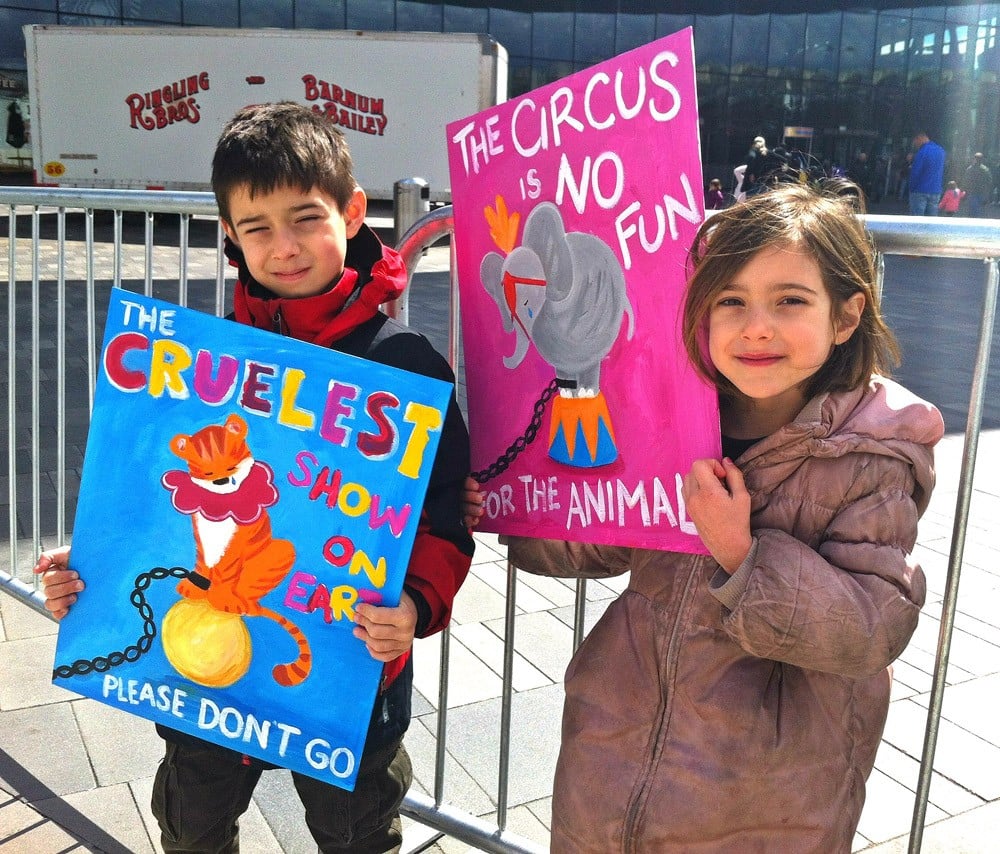



 ©iStock.com/CEFutcher


